
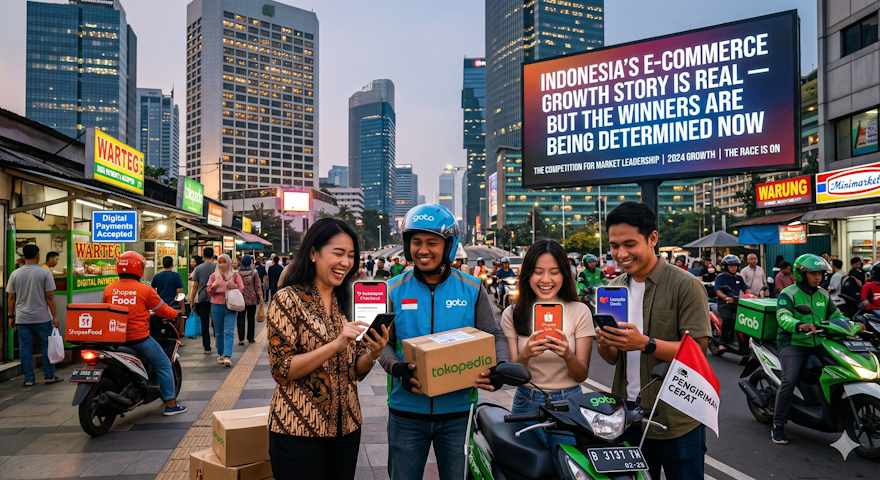
Key Takeaways |
1. Indonesia's e-commerce growth is structural, not cyclical: GDP at 5.11%, household consumption at 53.88% of GDP, e-commerce GMV +14% YoY. |
2. Category-level data tells a more important story than macro indicators — formula milk at IDR 1.6tn (+15.91% YoY) and beauty at Rp 27.17tn show who is capturing value. |
3. Mobile commerce exceeds 70% of Indonesia transactions — accessibility is no longer the barrier. Discoverability and trust are. |
4. Market concentration is increasing. The window for competitive repositioning is narrowing, quarter by quarter. |
Indonesia's e-commerce growth has been discussed optimistically for a decade. In Magpie's experience, the gap between macro optimism and category-level reality has historically been wide. Brands enter with projections built on GDP growth and internet penetration curves, and find that the actual competitive dynamics are far more granular than the top-line numbers suggest.
What has changed, based on Magpie's H2 2025 data across multiple categories, is that the macro story and the category story are now pointing in the same direction. Indonesia is genuinely in a structural e-commerce growth phase. And the critical implication is not that everyone wins — it is that the competitive positions being established right now are likely to persist.
What Do the Macro Numbers Actually Mean?
Indonesia's GDP grew at 5.11% in 2025. Household consumption accounts for 53.88% of GDP. E-commerce GMV grew at +14% year-on-year. Mobile commerce accounts for more than 70% of all online transactions.
These are strong numbers, but Magpie's view is that the macro figures are almost less important than what they signal structurally. A 70% mobile commerce share does not just mean 'Indonesians buy on phones.' It means that the friction to purchase has been eliminated for the vast majority of the population. The barrier to transacting online in Indonesia is no longer access. It is now discoverability, trust, and category-specific decision factors — which is exactly the territory where data-backed brand strategies win or lose.
The 14% GMV growth, meanwhile, is not coming equally from all categories. Magpie's cross-category intelligence shows that growth is concentrated in specific segments, and that within those segments, it is further concentrated among brands that have built deliberate e-commerce operations.
What Category-Level Data Reveals That Macro Data Hides
Formula milk in Indonesia reached IDR 1.6 trillion in GMV in H2 2025 alone — a +15.91% year-on-year increase, outpacing the overall e-commerce market. That is not a category passively riding macro tailwinds. That is a category with strong demand fundamentals and an increasingly sophisticated online buyer.
Indonesia's beauty and personal care e-commerce market reached Rp 27.17 trillion in GMV across March to December 2025, across 488.8 million units. To put that in context: that is a single country, a single channel, and only nine months of data.
Consumer electronics in Indonesia reached $701 million in online GMV, making Indonesia the largest electronics e-commerce market in Southeast Asia by volume — ahead of Thailand, Vietnam, and Malaysia. Indonesia is not just a large market. In electronics, it is the largest market in the region.
The macro narrative says Indonesia is growing. Magpie's category-level data shows which categories are growing faster than the market, which consumer segments are driving it, and where competitive concentration is occurring. Those are very different conversations.
Why the Window Is Narrowing — Not Opening
The counter-intuitive insight from Magpie's data is this: the fact that Indonesia is growing does not mean the market is becoming more open. It means it is becoming more concentrated. The brands that are scaling in formula milk, beauty, and electronics are not doing so randomly. They are doing so because they built the right e-commerce infrastructure — platform presence, content commerce operations, pricing architecture — before the market matured.
In condiments, Magpie's H2 2025 data shows that Soy Sauce as a sub-category is highly concentrated: a single dominant brand holds approximately 75% of the segment's online value. In formula milk, the Stage 3 formula sub-category — which accounts for 65% of total category GMV — is being contested by a small number of brands that have invested in the online channel over multiple years. In electronics, brand-name players are already contending with a no-brand segment that holds 18.7% of regional market volume.
In each case, the competitive structure did not emerge suddenly. It was built over quarters of consistent market investment. Brands looking at Indonesia's growth macro and assuming they have time to 'learn the market' before competing seriously are misreading the situation.
What Magpie Sees That Others Do Not
Most market intelligence in Indonesia's e-commerce space is either too macro (market sizing reports that aggregate across categories) or too narrow (platform-specific data from Shopee's seller tools or single-platform analytics). Magpie operates in the space between: we track specific categories, specific sub-categories, and specific platform dynamics simultaneously, across multiple categories at once.
The result is that our clients make decisions with a level of specificity that macro reports cannot provide and single-platform tools cannot match. A brand entering the formula milk market knows not just that the market is growing, but that Stage 3 formula accounts for 65% of value, that Shopee holds 71% of market share, and that the TikTok ecosystem represents 20% of GMV and is growing. That is the difference between entering a market and entering a market with a plan.
Indonesia's e-commerce growth story is real. But the brands who will look back on 2026 as the year they established a durable competitive position are those making decisions with category-level intelligence today — not those waiting for the macro opportunity to become more obvious.
Work with Magpie Magpie produces quarterly market intelligence across Indonesia's major e-commerce categories. If you are making investment decisions about Indonesia in 2026, we can give you the category-level data that macro reports cannot. Get in touch at https://magpieiq.com/#contactus |
About Magpie: Magpie is a Southeast Asia e-commerce intelligence and strategy firm. We produce proprietary market intelligence across FMCG, beauty, and consumer electronics in Indonesia, Thailand, and the broader SEA region — helping brand leaders make faster, better-informed decisions in one of the world's most dynamic digital commerce markets. Reach us at https://magpieiq.com/#contactus