
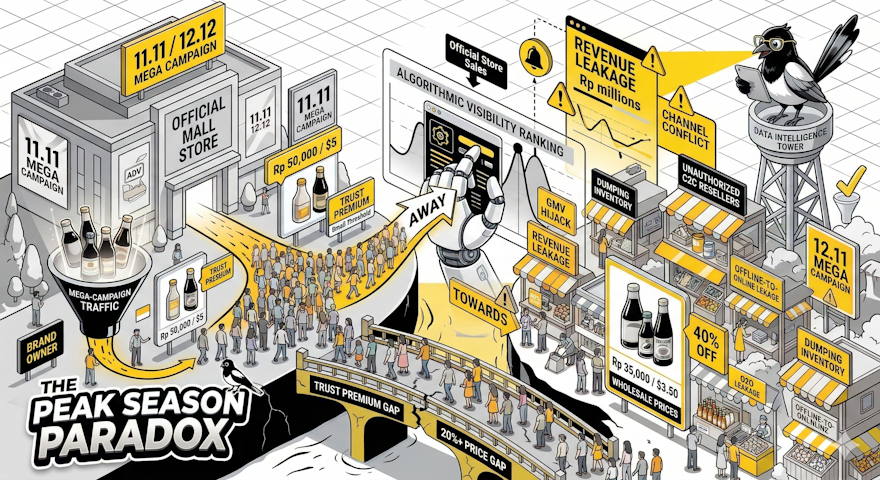
The fourth quarter is the undisputed Super Bowl of Southeast Asian e-commerce. Brands pour massive budgets into 11.11 and 12.12 mega-campaigns, buying up platform banners, funding TikTok livestreams, and driving immense traffic to their Official Stores. The expectation is simple: higher traffic equals record-breaking Official Store sales.
But what if your marketing dollars are actually subsidizing your own distributors?
At Magpie IQ, our recent analysis of the Indonesian FMCG space—specifically looking at the Condiments category in H2 2025—revealed a fascinating and costly trend we call the Peak Season Paradox.
During the Q4 rush, the condiments market accelerated massively, peaking at Rp228.6 billion in GMV in December. However, as the overall market surged, a counter-intuitive shift occurred: Official Stores actually saw a decline in market share and unit volume, while C2C (Consumer-to-Consumer) sellers captured the upside.
Brands were paying for the top-of-funnel marketing, but agile, third-party sellers were stealing the bottom-of-funnel conversions. Here is why this happens, the mechanics behind it, and how brands can plug the revenue leak.
1. It is Not a "Grey Market"—It is Channel Conflict
In FMCG, we often imagine unauthorized sellers as shadowy figures smuggling counterfeit goods. But for everyday items like soy sauce or chili sauce, the threat comes from inside the house.
This is a classic Offline-to-Online (O2O) leakage problem. As highlighted in industry analyses on channel management by firms like GrowthSqapes, severe conflicts occur when traditional offline distributors (General Trade and Modern Trade wholesalers) undercut direct sales channels.
Distributors have strict monthly offline targets. When they sit on excess inventory, they realize they can liquidate it much faster online than by pushing it to physical warungs. They create C2C marketplace accounts and dump authentic, branded stock at near-wholesale prices. During a mega-campaign, your Official Store isn't fighting rival brands; it is cannibalizing itself by competing against its own offline distributors.
2. The Math Behind the Madness: Why Platform Vouchers Aren't Enough
A common misconception is that Official Stores are protected during mega-campaigns because platforms like Shopee and Tokopedia heavily subsidize them with exclusive "Mall Only" vouchers (e.g., 20% off Shopee Mall).
But the math simply doesn't favor the brand. Even when a consumer applies a massive platform voucher to an Official Store purchase, the discount is being applied to the full Retail Price. Meanwhile, the C2C seller is working off a heavily discounted Wholesale base price. A 20% voucher on retail simply cannot compete with a distributor dumping stock at a 30% or 40% offline wholesale discount.
3. Breaking the "Trust Premium"
Consumers aren't naive; they generally prefer buying food and beverage products directly from Official Stores to guarantee safety, proper packaging, and distant expiry dates. We call this the Trust Premium.
Generally, consumers are willing to pay a 5% to 10% premium for this peace of mind. However, because O2O sellers undercut the price so aggressively during 11.11 and 12.12, they break right through the consumer's threshold. When the price gap stretches to 20% or more, consumers abandon their Official Store carts and prioritize pure savings over the brand guarantee.
4. The Algorithmic Hijack
In the SEA marketplace ecosystem, there is no Amazon-style "Buy Box" where sellers share one product page. Every seller has their own distinct listing. This creates a vicious cycle for Official Stores during mega-campaigns.
Because the C2C wholesale listings are significantly cheaper, they naturally generate incredibly high conversion rates. As noted in recent e-commerce conversion studies, such as those published in the Mabha Jurnal, marketplace search algorithms on platforms like Shopee reward high-converting listings with top organic visibility.
The result? The brand pays thousands of dollars for top-of-funnel platform traffic, but when the consumer searches for the product, the algorithm ranks the C2C reseller's listing above the Official Store.
How Brands Can Take Back the Digital Shelf
You cannot fight what you cannot see. If your e-commerce strategy only tracks the performance of your own Official Store dashboard, you are flying blind during the most critical sales months of the year.
To win during peak seasons, brands need total visibility over the entire marketplace ecosystem. This is where Magpie IQ changes the game.
Instead of just reporting on your own sales, Magpie IQ provides granular, whole-market intelligence. We help FMCG brands:
Track Total Market Share: See exactly how much GMV is flowing through your Official Store versus C2C sellers.
Monitor Pricing Parity & The Trust Gap: Track how third-party sellers are pricing your SKUs so you know exactly when they break your consumers' Trust Premium threshold.
Spot Distributor Leakage: Identify the exact volume spikes that indicate an offline distributor is dumping inventory online, allowing your commercial teams to address the channel conflict at its source.
The proprietary data from H2 2025 proves that driving traffic is no longer enough. To truly win mega-campaigns, brands must protect their digital shelf.
Interested in exploring our solutions? Let's talk.