
The metric you're using to track market share may be pointing you to the wrong competitor, the wrong pack size, and the wrong platform.
The Measurement Problem Nobody Talks About
Indonesia's e-commerce market is generating more data than ever. With the market forecast to reach USD 94.5 billion in 2025 and growing at a CAGR of 15.5%¹, brands and their commercial teams are swimming in dashboards — GMV by platform, units sold by SKU, value share by category. More data should mean better decisions.
But in FMCG categories where the same product sells in pack sizes ranging from 120 grams to 3,000 grams, treating every unit as equal is not a data problem. It is a measurement problem. And measurement problems compound quietly — until a brand finds itself losing household penetration to a competitor it thought it was beating.
The Number That Looks Fine Until You Look Closer
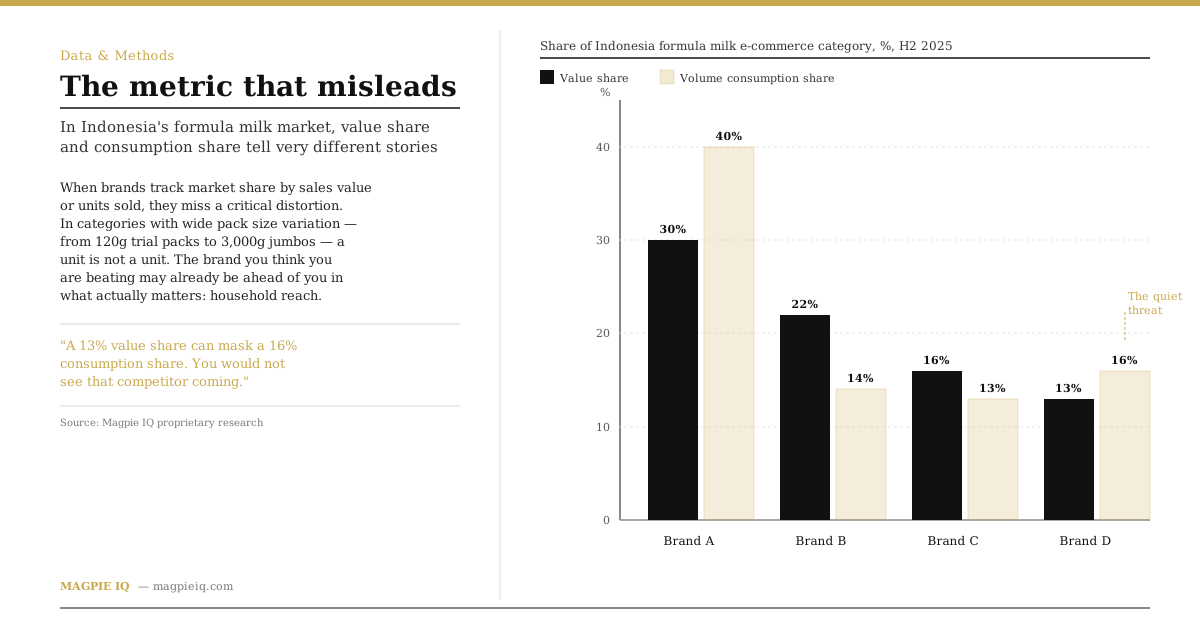
Consider the formula milk category on Indonesia's major e-commerce platforms in H2 2025, which Magpie IQ tracks at SKU level across Shopee, TikTok Shop, Tokopedia, Lazada, and Blibli. By sales value, the competitive picture looks legible. Brand A leads with 30% value share. Brand B holds 22%. Brand C sits at 16%. Brand D at 13%.
Now apply a consumption-weighted lens. Measure not transaction value, but total grams sold — what we call Volume Consumption, calculated as units sold multiplied by the gramasi weight of each SKU. The ranking does not just shift. The story changes entirely.
Brand A's consumption share rises to 40% — well above its value share, consistent with a pricing model built on affordable, high-volume packs. Brand B's consumption share falls to 14% — significantly below its value share, suggesting it is monetizing a shrinking base of loyal buyers rather than expanding household reach. Brand D reveals a quiet threat: a 13% value share masks a 16% consumption share, meaning it is reaching more households than its revenue figures suggest.²
If you were Brand C's commercial director relying on value share alone, you would not see Brand D coming.
Why the Unit-Based Metric Fails Here
The error is structural. In formula milk, pack sizes differ by a factor of 25 — from a 120g trial pack to a 3,000g jumbo. Counting them as equivalent units is like measuring rainfall by counting raindrops regardless of size.
In Indonesia's formula milk category in H2 2025, jumbo packs above 1,000g account for the majority of category sales value, while trial packs below 200g represent a small fraction. In unit terms the gap narrows considerably — trial packs transact far more frequently because they are low-commitment entry purchases.³ A brand optimizing for unit volume gets pulled toward small packs. A brand optimizing for GMV gets pulled toward premium pricing on mid-tier packs. Neither tells you which brand is actually building the deepest household consumption base.
The Two Errors That Cost the Most
The first is misreading the competitive threat. A brand tracking unit share can systematically underestimate a low-price, high-volume competitor quietly expanding its consumption footprint. By the time that threat appears in value share data, the competitor has built a loyalty base that is expensive to dislodge. TikTok Shop has shown the fastest platform growth in Indonesia, its model merging content, entertainment, and commerce⁴ giving agile, price-competitive brands a discovery engine that accelerates penetration faster than conventional metrics can track.
The second is misreading premiumization. A rising average selling price looks like a healthy signal. But in the formula milk category, certain brands exhibit value growth alongside volume consumption decline at the product stage level. The accurate interpretation is not premiumization — it is consumer base erosion. Fewer households are buying, but each remaining buyer is spending more per trip.⁵ GMV alone cannot tell these two situations apart, and the strategic responses they require are completely different.
Volume Consumption: A More Honest Starting Point
The fix is methodologically straightforward: calculate total grams sold across every SKU, then aggregate to brand, platform, and category level. Volume Consumption is agnostic to pack size and pricing strategy. It measures how much product is actually moving into households rather than how much revenue it generated on the way there.
At the platform level this reveals something equally actionable. TikTok Shop disproportionately drives multipack bundle sales in the formula milk category — x2 and x3 configurations dominating transactions — while Shopee shows broader pack size distribution.⁶ A brand reading platform performance by GMV alone would miss this and risk investing against the wrong pack architecture on the wrong platform.
To be precise about the limits: Volume Consumption excludes offline sales, does not capture actual in-home consumption, and requires consistently normalized SKU-level gramasi data across every platform to be reliable. It is not an industry standard — it is an analytical choice we believe produces more accurate competitive intelligence in pack-size-variable categories.
The Bottom Line
In the first half of 2025, 95% of Indonesian respondents made online purchases, up 4% year-on-year, with TikTok Shop usage climbing from 40% to 46% over the same period.⁷ The volume of transactions is only going in one direction. The brands that build measurement frameworks precise enough to read what those transactions actually mean will have a durable advantage over those that do not.
Volume Consumption is one piece of that framework. Not the whole answer. But a more honest starting point than counting boxes.
Want to See What Your Category Actually Looks Like?
If this analysis raises questions about how your brand is being measured — or how your competitors are being read — we would be glad to show you what consumption-weighted data looks like applied to your specific category and platform mix. Magpie IQ tracks SKU-level sales data across Indonesia's major e-commerce platforms, covering FMCG, baby care, and consumer health categories across Shopee, TikTok Shop, Tokopedia, Lazada, and Blibli.
Get in touch at or visit us at magpieiq.com.
Footnotes
¹ Indonesia 2025: Ecommerce & Payments Trends Analysis — https://paymentscmi.com/insights/indonesia-ecommerce-payments-trends-2025/
² Magpie IQ proprietary research
³ Magpie IQ proprietary research
⁴ Indonesia eCommerce Market: Data, Trends, Top Stories — https://www.indonesia-investments.com/business/business-columns/indonesia-ecommerce-market-data-trends-top-stories/item9630
⁵ Magpie IQ proprietary research
⁶ Magpie IQ proprietary research
⁷ Online Shopping 2025: Essentials Rise, Secondary Products Decline — https://insight.jakpat.net/online-shopping-2025-essentials-rise-secondary-products-decline/