Indonesia's online condiments and sauces market is growing quickly, but the most useful signal is not the headline rate. According to Magpie IQ data, tracked GMV reached US$5.1 million in May 2026, up 35% year on year. Bango remains the clear leader with 21.6% of GMV across March–May, yet the largest recent gains came from a different group: Eatsambel, Cap Sawi and Dapoer Kuno.
This is not a story about an incumbent suddenly losing control. It is a story about a market expanding underneath the leader. Ecommerce is giving product-led sambal challengers room to build meaningful scale while the established leader holds its number-one position.
How big is Indonesia's online condiments market?
Magpie IQ tracked US$16.0 million in category GMV across March, April and May 2026. May alone contributed US$5.1 million, 35% more than the same month a year earlier. The tracked category is overwhelmingly sweet soy sauce and chili sauce, which makes the growth commercially relevant to brands competing for everyday Indonesian meal occasions rather than to a broad, loosely defined grocery basket.
The market is also less concentrated than a quick glance at the leader might imply. Bango generated US$3.4 million across the latest three months, equal to 21.6% of category GMV. The next two brands—Eatsambel and Kewpie—each held 6.8%, or roughly US$1.1 million. Cap Sawi followed at 4.3%, while Mc Lewis and Dapoer Kuno each held about 4.0%.
That distribution matters. The number-one brand is more than three times the size of the nearest individual challenger, but nearly four-fifths of category GMV sits outside the leader. For brand managers, that is the profile of a market where leadership is real and the contest beneath it remains open.
Which sambal brands are gaining online?
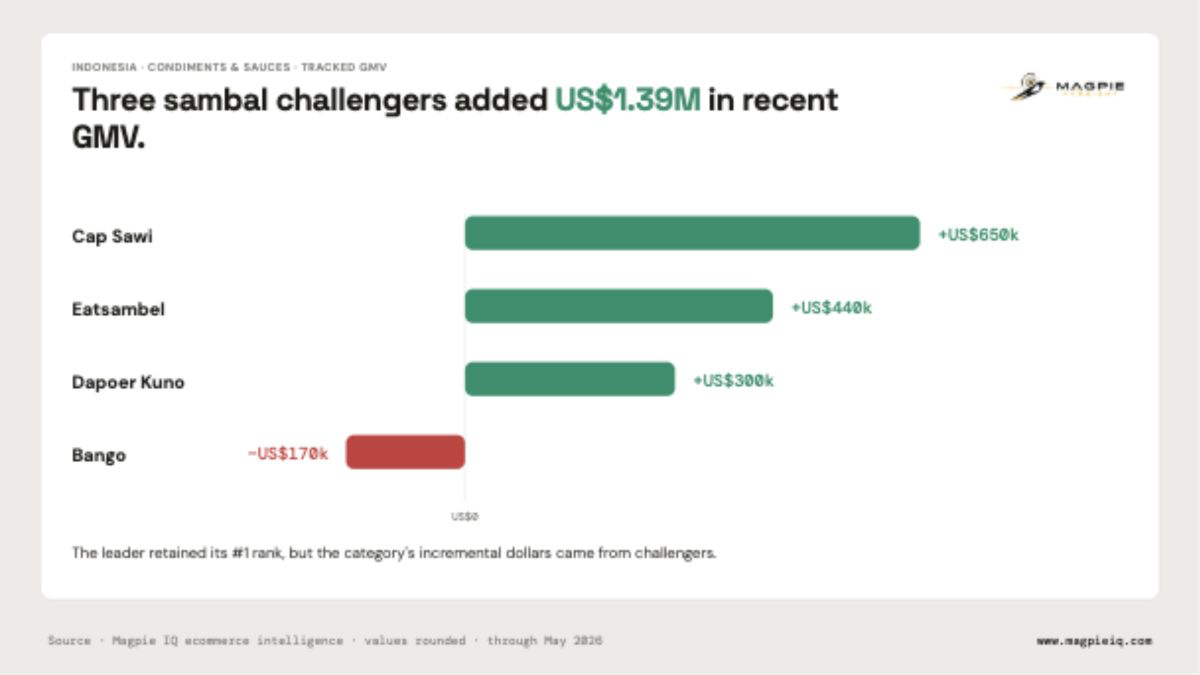
The strongest recent momentum belongs to Cap Sawi, Eatsambel and Dapoer Kuno. Comparing March–May 2026 with the preceding three months, Magpie IQ recorded gains of approximately US$650,000 for Cap Sawi, US$440,000 for Eatsambel and US$300,000 for Dapoer Kuno. Over the same comparison, Bango was broadly steady, with GMV lower by about US$170,000 while retaining the number-one rank.
These are absolute changes, not percentage-growth theatrics from a tiny base. Together, the three gaining brands added about US$1.39 million between the two three-month windows. That is the clearest evidence that challenger momentum is contributing real dollars to the category, even while no single brand is close to Bango's scale.
Eatsambel is the most visible example of how a digital-native proposition translates into marketplace demand. Its own site emphasises product development, multiple flavour variants and direct-to-consumer service; its official Shopee store displays a broad assortment spanning jars, sachets and bundles. Those observations do not prove why the brand grew, but they fit the commercial pattern in Magpie IQ's sales data: differentiated products and ecommerce-ready packs can create more buying occasions than a single staple format.
The nuance is important. Kewpie's 6.8% share shows that this is not exclusively a local sambal race; mayonnaise has a meaningful position inside the tracked category. But the recent gainers are led by Indonesian chili-sauce brands. The category's growth is therefore broad enough to support adjacent formats while the clearest competitive movement is happening in sambal.
Is TikTok Shop driving the challenger wave?
Not by itself. Shopee accounted for 67.7% of tracked category GMV across March–May 2026, equal to US$10.8 million. Tokopedia | Shop contributed 21.2%, or US$3.4 million, while TikTok Shop contributed 7.1%, or US$1.1 million.
That platform split complicates the easy social-commerce narrative. Sambal challengers may be content-friendly, but the category's transactions still happen primarily on Shopee. A brand can use creators and short-form video to generate demand, yet it still needs strong search visibility, official-store execution, reviews, bundles and replenishment mechanics on the marketplace where more than two-thirds of tracked GMV lands.
Tokopedia | Shop is too large to treat as a secondary afterthought: its 21.2% share is three times TikTok Shop's direct contribution in this dataset. The practical lesson is a portfolio one. Discovery can happen anywhere; conversion capacity has to be built where category buyers are already spending.
What This Means for Food Brands
1. Defend the staple, but watch the premium edge. Bango's 21.6% share confirms the power of the established everyday proposition, while US$1.39 million in combined recent gains for Cap Sawi, Eatsambel and Dapoer Kuno shows where incremental competition is forming.
2. Build assortment for ecommerce behaviour. Bundles, sachets and distinct flavour variants give shoppers reasons to add, trial and repeat. Eatsambel's 6.8% share demonstrates that a challenger can turn that assortment logic into material category scale.
3. Put marketplace fundamentals ahead of platform fashion. Shopee still captured 67.7% of category GMV in the latest three months. Content may stimulate demand, but availability, ratings, pack architecture and promotion on Shopee remain the larger commercial lever.
4. Measure movement in dollars as well as percentages. Cap Sawi's approximate US$650,000 gain between consecutive three-month periods is strategically more useful than a large growth percentage without a base. Absolute GMV movement shows whether a challenger is becoming commercially consequential.
About the Data
Magpie IQ has tracked Indonesian ecommerce at SKU level since 2021 across Shopee, Tokopedia, TikTok Shop, Lazada, Blibli and Bukalapak. Five years of continuous data, not a survey or a one-time snapshot. The same intelligence infrastructure is trusted by major FMCG companies operating in Indonesia and Southeast Asia.
Sales Value (GMV) is calculated as final post-discount price × units sold (Terjual), with price held constant at the latest snapshot within the reporting period. This analysis covers Indonesia's online condiments and sauces category through May 2026. Platform coverage differs by period, so the year-on-year category figure should be read as a tracked-market comparison rather than a like-for-like platform panel.
All data is Magpie IQ proprietary research. It is provided for informational purposes only and is presented as-is without warranties of any kind. Magpie IQ makes no representations as to the completeness or accuracy of this information and accepts no liability for decisions made in reliance on it.
The Broader Picture
- How Eatsambel describes its product strategy
The brand's own account of its flavour development, quality positioning and expansion into restaurant supply.
- Eatsambel's official Shopee storefront
A live view of the jars, sachets and multi-product bundles behind its marketplace assortment.
- An earlier snapshot of online sambal competition
Compas documented Eatsambel's ecommerce traction in 2022, providing useful historical context for Magpie IQ's 2026 category view.